
Cow teeth anatomy refers to the number and classification of the permanent teeth. It is a part of the mouth cavity proper of the cow’s digestive system.
Here, I will discuss the total number and types of permanent teeth from the cow’s mouth.
Quick answer: Cow teeth anatomy includes four types of permanent teeth (incisor, canine, premolar, and molar) with a total of 32 in number.
However, I will describe the structure of an ideal cow tooth with hand-drawing diagrams.
Cow teeth anatomy
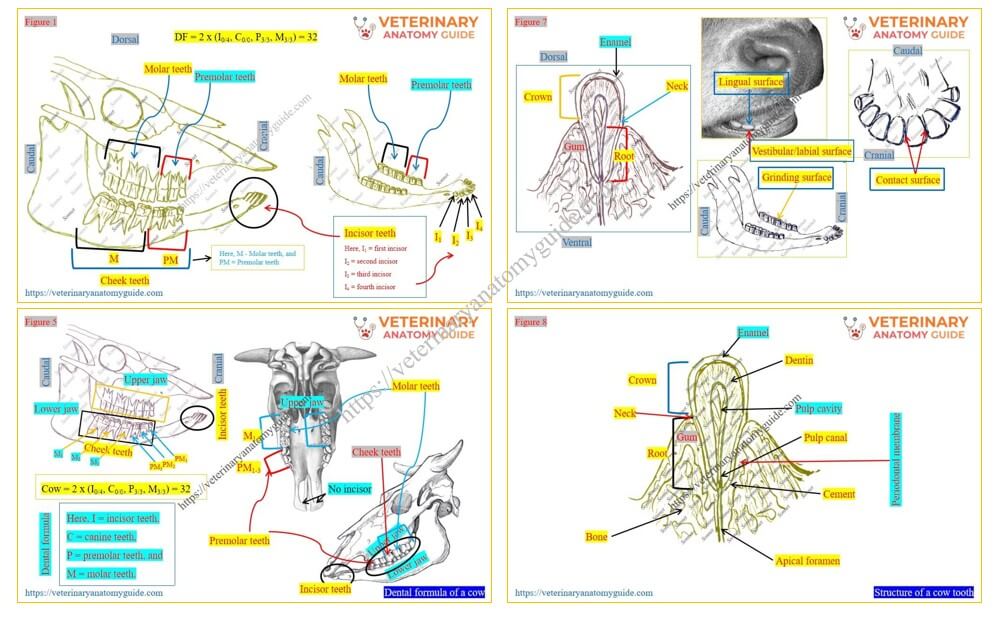
Figure 1 shows the schematic diagram/presentation of the various permanent teeth of a cow. These teeth are the white or yellowish white structures implanted in the alveoli of the cow’s jaws.

Here, the cow’s upper and lower jaws are formed by the maxilla and mandible bones, respectively.
Thus, you may say that the cow’s teeth are arranged into two dental arcades. However, this type of arrangement of the cow’s teeth is known as thecodont.
Here, Figure 2 presents a gap in the lower arch/jaw in between the incisor and cheek teeth (premolar and molar). This may be a physiological gap and is termed the diastema.

You may easily notice the diastema between the canine tooth and the first premolar tooth in the cow’s lower jaw. However, the vestibular cavity and the mouth cavity proper communicate through this diastema.
Followings are some other terminologies that you might know while learning the cow’s teeth anatomy –
- One, Heterodonty
- Two, Dihyodonty and polyphyodonty
- Three, erupt and come into wear
What is heterodonty in cow teeth?
Figure 3 presents permanent teeth from various animals (cow, horse, and dog). Here, the number of teeth varies greatly from animal to animal.

In cow, the shape, size, and number of the teeth are specialized comapred to others for different aspect of prehension and mastication. This type of arrangement of the teeth in a specific animal is termed heterodonty.
What is diphyodonty in cow teeth?
To understand the term diphyodonty, you might know the two sets of teeth of a cow –
- Set 1: Decidous teeth/baby teeth/milk teeth, and
- Set 2: Permanent teeth,
Diphyodonty: Here, one set of deciduous teeth is replaced by only one set of permanent teeth. This replacement is termed the dihyodonty in a cow.
Polyphyodonty: In some of the animals, several sets of teeth are formed throughout the life. These features of several sets of teeth are known as polyphyodonty.
Now, let’s see what the deciduous and permanent tooth sets, along with their dental formula, are. However, the dental formula express the number of different types of teeth (incisor, canine, premolar, and molar) both on the cow’s upper and lower jaws.
Deciduous teeth in cow/calf
Figure 4 presents a schematic presentation/diagram of the temporary set of teeth on the calf’s mouth. These are the first set of teeth erupts during early life (at birth or within a few weeks after birth).

The first set of teeth is also known as the deciduous teeth/baby teeth/milk teeth. The dental formula for the deciduous teeth/milk teeth/temporary teeth for a calf is –
2x(DI0/4, DC0/0, DP3/3) = 20
Here, DI = deciduous incisor, DC = deciduous canine, and DP = deciduous premolar teeth.
The last tooth of the rostral group is resemble to incisor. However, it is sometimes called the canine on the basis of development and evolutionary aspects.
Here, Table 1 shows the eruption time of the deciduous teeth in a calf –
| Type of teeth | Eruption time in calf |
| Deciduous incisors | Birth to 2 weeks |
| DI1 | Birth to 2 weeks |
| DI2 | Birth to 2 weeks |
| DI3 | Birth to 2 weeks |
| DI4 | Birth to 2 weeks |
| Deciduous premolars | 1 to 4 weeks |
| DP1 | 1 to 4 weeks |
| DP2 | 1 to 4 weeks |
| DP3 | 1 to 4 weeks |
Permanent set of teeth in a cow
Figure 5 shows the dental formula of a full-mouth cow. It also shows the schematic presentation of the permanent set of teeth of a cow.

After a specific time, the temporary set of teeth is replaced by another set of teeth. The second set of teeth of a cow is the permanent teeth.
The eruption of the cow’s permanent teeth starts at the age of one. However, the cow needs almost 3 – 4 years to complete the eruption of the permanent teeth.
The dental formula of a cow’s permanent teeth for a cow is –
2 x (I0/4, C0/0, P3/3, M3/3) = 32
Here, I = incisor, C = canine, P = premolar, and M = molar teeth. Thus, the cow has no canine teeth (Getty, 2000).
Table 2 shows the eruption time of the permanent teeth of the cow –
| Type of teeth | Eruption time in calf |
| Permanent incisors | 1.5 – 4 years |
| I1 | 1.5 – 2 years |
| I2 | 2 – 2.5 years |
| I3 | 3 years |
| I4 | 3.5 – 4 years |
| Permanent premolar | 1.5 years – 3 years |
| P1 | 2 – 2.5 years |
| P2 | 1.5 – 2.5 years |
| P3 | 2.5 – 3 years |
| Permanent molar | 5 months – 2.5 years |
| M1 | 5 – 6 months |
| M2 | 1 – 1.5 years |
| M3 | 2 – 2.5 years |
What is a dental pad in a cow?
If you notice Figure 5 and also the permanent dental formula, you will not find any incisor at the upper jaw or incisive bone. This placed is occupied by the connective tissue structure and is known as the dental pad.
However, the canine teeth are also present in the lower jaw only. Again, both incisor and canine teeth of a cow present a concave lingual surface and a convex labial surface.
What do the terms erupt and come into wear mean?
Figure 6 shows the growing teeth emerging from the gum of the cow’s mouth cavity. These teeth are said to be erupting.

However, the grinding/occlusal surface of these teeth meet these of the teeth of the opposite arcade. In this condition, they are said to have come into wear.
Now, I would like to describe the ideal structure of a cow’s teeth. Thus, you may easily understand the variation of individual types of cows’ teeth while describing them separately.
Structure of a cow tooth
Figure 7 presents three different major parts and 4 various surfaces of an ideal tooth of a cow.

Here, the 3 different parts of the cow teeth anatomy are –
- Crown/body: It lies above the gum and is covered by enamel.
- Root: It is embedded in the alveoli in the gums/jaws.
- Neck: It is the junction between the crown and root of the tooth, which is a little constricted.
However, the surfaces of a cow’s tooth are –
Occlusal surface/table surface/masticatory surface/grinding surface: It is the upper free surface of a tooth. It remain opposition to the tooth of the opposing jaw.
Vestibular surface: This surface is facing towards the vestibule of the cow’s mouth.
Labial surface: It is the vestibular surface of the incisor and canine teeth of the cow’s lower jaw. This is because these teeth face towards the cow’s lips.
However, the vestibular surface of premolar and molar teeth is also known as the buccal surface. This is because the surface is facing toward the cheeks.
Lingual surface: It is the surface that faces towards the cow’s tongue.
Contact surface: The surface of a tooth that remains in contact with the neighbouring tooth is called the contact surface.
Thus, a cow’s tooth has two contact surfaces on either side.
External and internal features
Figure 8 presents different features of the cow’s tooth structure. Here, you will find mainly the dentin, dental cavity, pulp, pulp cavity, cement, and enamel.

Let’s try to identify and understand the followings external and internal features from a cow’s tooth structure –
Dentin and dental cavity: Most of the tooth substance of a cow is composed of mineralized substance, which is dentin. It is a hard, yellowish-white substance that forms the bulk of a tooth. However, it also contains a center dental cavity that continues with a pulp cavity.
Pulp and pulp cavity: Within the dentin, there is a soft structure in the center, which is known as pulp. It presents a pulp cavity that extends towards the root and forms a pulp chamber.
However, It become narrow at the root and forms the pulp canal. Finally, the pulp canal opens into the apical foramen of the tip of the root.
Here, the pulp cavity consists of a gelatinous connective tissue, vessels and nerves. A layer of odontoblast cell lines the pulp canal.
What are the cement and enamels?
Figure 9 shows a thin yellowish material that covers the implanted narrow root of the cow’s teeth. It is harder than the dentin and covers the dentine of the root only.

This thin layer is the cement, and for some of the teeth of a cow it become thick layer.
The figure also shows that a hard translucent materials cover the upper exposed part of the cow’s teeth. It is the enamel and is considered the hardest tissue in the body.
However, the enamel strongly covers the dentine of the tooth’s crown. It is bluish white in color.
At the root, you will find a connective tissue between the bony alveolus and the cement. It is the periodontal membrane and helps in suspending the tooth in the alveolar socket.
Now, I will discuss the various types of teeth from the cow’s mouth cavity.
Classification of cow teeth
Figure 10 and the previously expressed dental formula of a cow show that there are 4 different types of teeth. These teeth are classified based on their position in the alveolar socket and also the function performed by them.

- Incisor teeth: The front teeth are the incisors and are used for cutting the feed materials.
- Canine teeth: These are the next to and lateral to the incisor teeth. According to world famous anatomist, this type of canine teeth is absent in cows.
- Premolar teeth: These are the next to and lateral to the canine/last incisor (sometimes in cows).
- Molar teeth: These teeth are located next to the premolar. However, the premolar and molar teeth form the sides of the dental arches.
These teeth are adjacent to the cheek, and thus, the premolar and molar are also known as cheek teeth. They are used for grinding, chewing, and mastication of the feed materials.
The incisor, canine, and premolar teeth will appear in both deciduous and permanent sets of teeth in a cow. However, the cow’s molar teeth only erupt when the permanent set of teeth has developed.
Incisor teeth anatomy of a cow
Figure 11 highlights the incisor teeth from the cow. It shows that the upper jaw (incisive bone) lacks the incisor teeth.

Here, the lower jaw of a cow presents eight incisors, which are arranged in a fan-like manner.
How many incisor teeth does a cow have?
You may see the variation in the number of incisor teeth (6-8) in different reference books. Thus, you might have the question: why are incisors six or eight in number?
Explanation: Well, I have already stated that the fourth tooth on the front side also resembles other incisors. Thus, many authors (Getty, 2000) considered the fourth front teeth as incisors and expressed the dental formula as 2 x (I0/4, C0/0, P3/3, M3/3) = 32.
However, on the evolutionary and development point of view, this fourth tooth is actually the canine tooth. Thus, many other authors (Ghosh, 2000; Rowen, 2007) considered this tooth as the canine and expressed the dental formula as 2 x (I0/3, C0/1, P3/3, M3/3) = 32.
So, which one should you accept? Well, on my side, I am okay with the statement of Getty (2000). I have also observed similar features of the last front teeth as the incisors.
How to designate and number the incisors of a cow?
The incisor teeth of a cow are designated by the letter I and used in the dental formula (Figures 4 and 5). Now, I will discuss how you will number these incisors.
Well, the incisor teeth are numbered starting from the midline of the cow’s lower jaw. Thus, Figure 12 presents the first pair of the cow’s incisor teeth.

However, Table 3 shows the designations and names of three pairs of incisors of a cow –
| Cow’s incisors | Designation | Name of the incisors |
| First pair of incisors | I1 | Centrals |
| Second pair of incisors | I2 | First intermediates |
| Third pair of incisors | I3 | Second intermediates |
Special features of the cow’s incisors
The cow’s incisors are simple teeth that have no infundibula. Here, the crowns of these incisors are white, short, and shovel-shaped.
The masticatory surface of the cow’s incisors presents a sharp edge. They are responsible for separating the labial and lingual surfaces of the incisors.
At the first stage, the crown of the cow’s incisor is covered with enamel. But, gradually, these enamel tears and the inner layer of the dentine are exposed.
However, the cow’s incisors present a single and rounded root. They are embedded in the alveolus on the alveolar border of the body of the mandible.
Features of the canine teeth
So, the canine teeth are absent in the cow, and well-developed in the horse and the dog. They are the fourth pair of teeth from the front and lateral to the third pair of incisors.
These canine teeth of the horse and other animals also have a single, rounded root. However, the crowns of the canine teeth are white or yellowish white. It becomes tapered towards the masticatory surface and slightly curved inward.
Cheek teeth/ premolars and molars of a cow
Figure 13 highlights the cheek teeth (premolars and molars) from the cow’s mouth. Here, the upper cheek teeth are embedded in the alveoli of the maxillary bone. However, the cow’s lower cheek teeth are embedded in the alveoli of the body of the mandible.
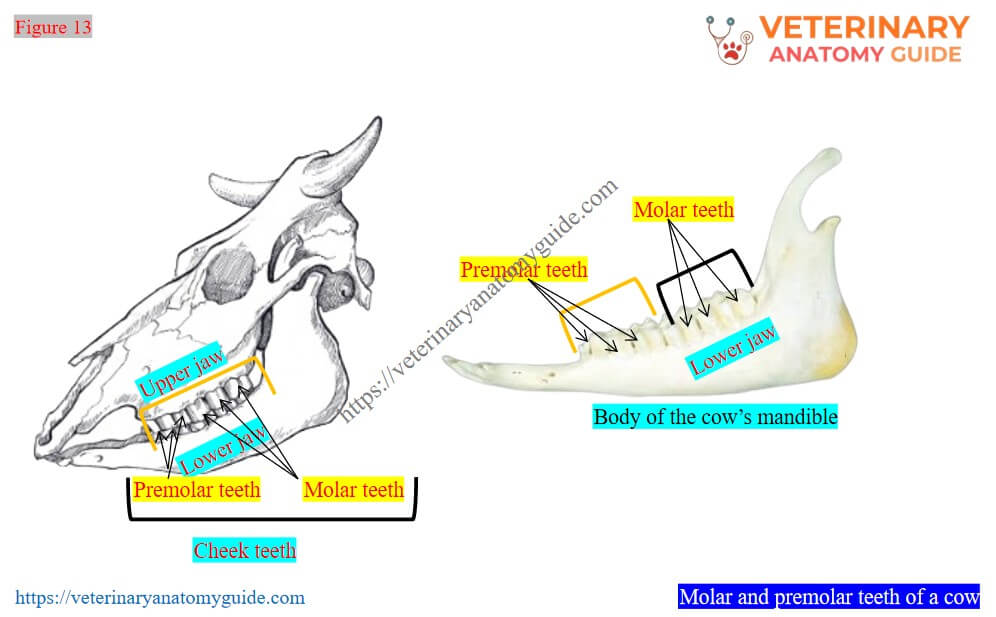
Here, the upper cheek teeth are longer on the outer side. However, the lower cheek teeth are longer on the inner side of the cow’s mouth.
Except for the first and last, the crowns of the premolar and molar teeth of the cow are quadrilateral in cross-section. Again, the first and last cheek teeth are triangular in cross-section.
All these cheek teeth are slightly curved with the convexity towards the cheek. You will find a little difference in the surfaces, edges, and roots between the upper and lower cheek teeth.
Upper cheek teeth
Surfaces and edges: The buccal surface of the upper cheek teeth presents a central ridge and two grooves. Again, the lingual surface presents a wide, rounded ridge that separates the two grooves.
However, the masticatory surface of the upper cheek teeth presents two prominent infundibula. They slop obliquely downwards and outwards.
The buccal edges of these upper cheek teeth are prominent and sharp.
Roots: In the case of the cow, the first and last upper cheek tooth has three roots. However, the rest of the upper cheek teeth have three or four roots.
Lower cheek teeth of a cow
Surfaces and edges: The lingual surfaces of the cow’s lower cheek teeth present two or more grooves. Here, the masticatory surfaces of these teeth are oblique.
This maticatory surface slopes upward and inward. Again, the lingual edge of this surface is sharp.
Roots: The first five lower cheek teeth of the cow have two roots. However, the last/sixth lower cheek tooth has three roots.
FAQ’s on cow’s teeth anatomy
The upper jaw of a cow lacks the incisor and canine teeth. Thus, there are a total of 12 teeth in the upper jaw of a cow, and all are the cheek teeth (premolar and molar).
However, the lower jaw have total of 20 teeth (incisor, premolar, and molar). Thus, there are 32 teeth in the cow’s dental formula.
Having two types of teeth (deciduous incisors and deciduous premolars) is only found in calves. As there are only 2 types of deciduous teeth, their age may be a few weeks.
However, if you found three types of teeth (incisors, premolars, and molars), then it might be a cow. The age of that cow may vary from 1.5 to 2.5 years.
Conclusion
So, the cow teeth anatomy describes the various terms related to it along with the classification. The ideal structure of a cow’s teeth presents its parts (crown, neck, and root), which are essential to differentiate incisors, premolars, and molars.
However, the complete dentition of a cow is expressed in the form of a dental formula. In the formula, the letter indicates the types of teeth, and the numerical value indicates the total number of teeth from the upper and lower jaws.
References
- Ghosh, R. K.: Primary veterinary anatomy, 2nd Edn.Current Books International, Kolkata.
- Rowen D. Frandson, W. Lee Wilke, and A. Dee: Anatomy and physiology of farm animals, 4th edn.Wiley-Blackwell, USA.
- Tulloh N. (1962) A study of the incisor teeth of beef cattle. Australian Journal of Agricultural Research 13, 350–361.
- Getty, R. Sission and Grossman’s The anatomy of the domestic animals, 5th Edn. W. B. Saynders and Co., Philadelphia (USA).
- Clauss, M., et al., (2022). Horse and cattle breeds have larger teeth. Journal of Experimental Zoology, 338(8), 561–574.
- Nickel, R., Schummer, A. and Seiferle, E.: The anatomy of domestic animals, 1st Edn. Verlag Paul Parey, Berlin.
- Chaoyang Wang, et al.,(2021). Enamel microstructural features of bovine and human incisors, Annals of Anatomy – Anatomischer Anzeiger, Volume 235, 151700, ISSN 0940-9602.
- Hermanson et al., Miller and Evan’s Anatomy of the Dog, 5th Edn. Elsevier.
- Mcleod, W. N.: Bovine anatomy, 2nd Edn. Burgess Publishing Co., Minneapolis.
- Dyce, K. M., W. O. Sack and CSG Wensing: Textbook of Veterinary Anatomy, Lea & Febiger. Philadelphia
